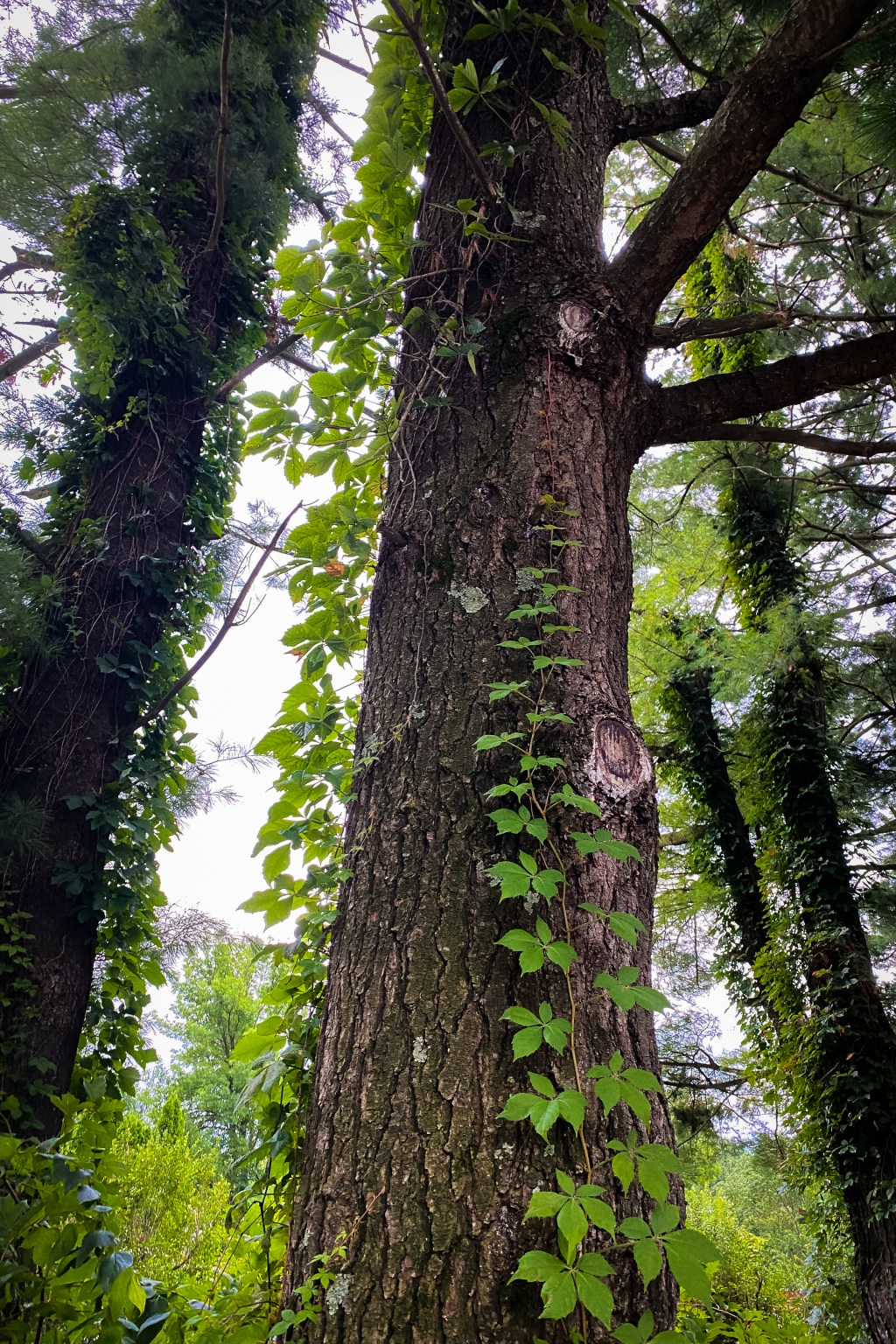
Earlier this week, I came across this Tumblr post by headspace-hotel, talking about how learning about plants has fundamentally changed how they look at the nature around them daily. I’ve been ruminating on my own similar journey, especially how it’s effected my writing.
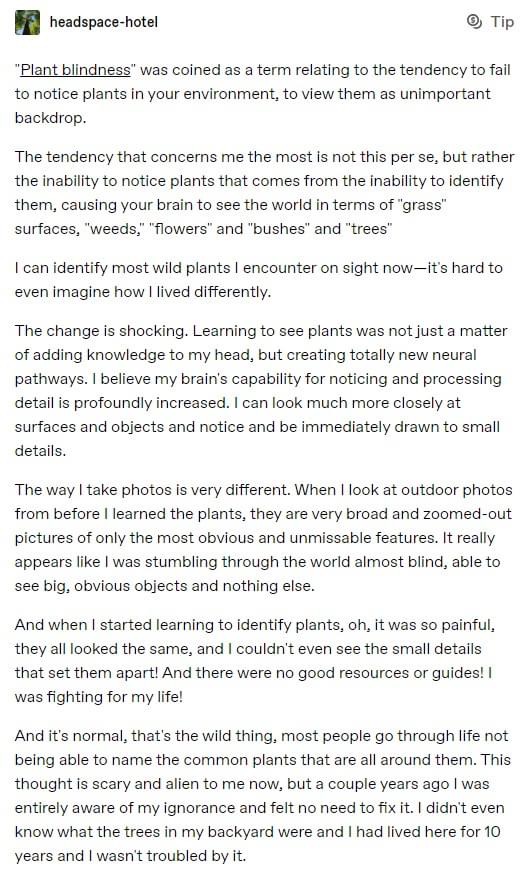
My life experience prior to learning about native plants was much the same as what the OP describes here. I liked nature, but largely things fell into categories of weeds, trees, bushes, and the rare plant I actually knew. And when I look back on my writing from when I was younger, I see a similar trend. Not only do most of the stories I wrote when I was younger take place almost exclusively in a city or town, but the descriptions of what little nature there was to be found are only as descriptive as that.
And for both memory and writing, the imagery I see is the same. My earlier memories of being out in the woods is just generic trees and bushes and weeds. What I see in my head when I read back these stories is just generic trees, the odd bush, and then one or two specific garden flowers. Yards were just yards. Flat, uniform nothingness (to be fair, that’s still how I view lawns).
Now though when I go outside, even in a town or city, I notice little things I never used to. I have names for different plants that used to look so similar but now seem so starkly different. I find myself wondering, “Has this plant always grown here?” when spotting something new and fascinating, wondering how I could’ve overlooked it all this time.
And in my writing, nature has expanded too. And not just the plants. Now, if a character spots a bird in a scene, I stop to ponder, what kind of bird? What does it look like? What does it sound like? What does the air smell like? What does the wind feel like? All of these things change how a scene could progress and the choices a character could make.
When I was younger, I always had this idea that writers were just better at finding words to describe things. That there was this innate ability to just pick a random tree or animal name and describe it with authority even if they didn’t know anything about it. It didn’t take me long, after getting into writing, to realize that (at least for me) this was not true. And from what I’ve learned as I’ve gotten older, it is largely true of all writers that we are a wealth of random, seemingly useless knowledge. And that’s what we pull on when we write. Because for most of us, it can’t just be any tree. It has to be one that would believable grow in the setting of the story with features believable for the time of year.
And I don’t think it’s merely a coincidence that so many of us love random facts. Having a keen eye for detail and a love of learning are both important qualities for writers. They are qualities that help us improve our writing. We notice things that others might not, and because of that, we can show people things that they might not otherwise see.
So we amass random knowledge on varying topics, some relevant to our daily lives, others not. And one way or another, it all ends up in our writing.
So for any first time writers out there, this would be my best advice: be curious. Learn about things even if they don’t seem valuable to you. Learn about everything and anything that presents itself. It’ll come in handy some day.

 L. Genevieve Writes
Leave a comment