
How do you world-build in your stories? Do you write vast, magical landscapes, unlike anything in our world? Or do you make subtle changes that become apparent in bits and pieces?
When I first started writing as a lonely pre-teen, I wrote to escape, and I used magical worlds I was already familiar with as backdrops for my fantasies. As I got older, I decided that fantasy stories were immature and “real” writers wrote stories about the “real” world. Now, I’ve truly come full circle with Wilderlands, which marries my world (literally the ground I stand on at this very moment) with the high fantasy I relished as a kid.
And, you know what? It’s so much more fun than when I was trying to meet some vague definition of “real” writer. My prose isn’t lofty and hard to digest, and my world isn’t concrete and mundane. College-age me would be appalled!
But I’m having fun. And the world I’m creating is so much richer for it.
I’ve been emailing with my editor this week (I have an editor. Me. Lil old me. That’s crazy.), and we’ve been talking shop about the world I’m creating in my story. I’ve shared a ton of the background of the world that hasn’t actually made it into the book yet, and it made me realize just how much time and energy I’ve actually put into creating this world.
Because it’s not like I sit down every day and think, “Today, I’m going to plot the socio-economic flow of goods that keeps this world afloat.”
I’ve had little epiphanies while doing other things or filled in gaps for details as I need them as I continue to write the story. I’ve explored motivations and backgrounds for characters that will never make it into the actual series, and doing so has required learning more about the world in which they live. And I’ve got all these little pieces, individual strings that weave into the tapestry of this larger world that I’ve never actually sat back and looked at.
Now, for the first time, I have an outside person asking me questions about this world, and I find myself referring to real historical events or places from all over the world. And I’m thinking, “When did I decide that exactly?” “Did I know that’s what I was basing this on?” Yes, on some level I must have, but it’s not like I ever wrote it down anywhere or blatantly decided that’s what it was based on.
See, I’ve always been a huge fan of history, arts, and culture. I love a good archeological article and seeing artist’s interpretations of what things might have looked like in the past. I love learning about other cultures and their practices. I love mythology and folklore.
I’ve been soaking up all this knowledge for the over three decades that I have been occupying this meat suit I call a body, and now, it’s like I finally figured out what it’s all for.
The world of Wilderlands is Minnesota, but not a Minnesota anyone would recognize. I still don’t even know if there will be enough hints in the text to give that much away. If I even want there to be.
But I’ve never been good at building worlds from scratch. Even when I write fiction based on our world, I struggle to create details that could have an exact answer. When I wrote a story set in Asia and the characters needed to flee India and find refuge in some holy temple in another country? I didn’t just pick a random city and make up the amount of time and mode of transit they took to get there. I used a site called Rome2Rio to see where they could get in the amount of time I wanted it to take, and carefully plot out how, precisely, they got there.
Because it makes a difference if they took a train, or a plane, or a bus. Or some complex matrix of taxi, bus, train, and hoofing it.
To some people, my methods might seem neurotic, but the more concrete I can make the details, the more enthralled I am with my world the more inspired I am to keep it going.
With Wilderlands, I knew I wanted it to be based in Minnesota. Growing up, I always wished there were stories that looked like my home but were fantasy; the way the books I read always looked like England, but they were fantasy. I wanted my world to feel magical when all I saw in real life was . . . farms. With the fantasy I grew up on, I just didn’t see how a world like that could ever exist.
It wasn’t until I was much older that stories began to emerge with post-apocalyptic worlds based on America. And that was closer, but still not right. I wanted magic and adventure, not grit and ruins . . . Okay, maybe some ruins.
My first real example of this sort of merging of the two ideas came in shows like Adventure Time. Shows that blurred the boundary between fantasy and sci-fi/dystopian storytelling. It’s thanks to these unlikely sources that I really began to look at the landscape of my own home and see how it might be warped by magic.
My first images of the world that would become Wilderlands came from looking at sites topographic-map.com, zooming in to an arbitrary level, and saying, “Okay. Everything in red is the new existing landmass. Everything else is water.”
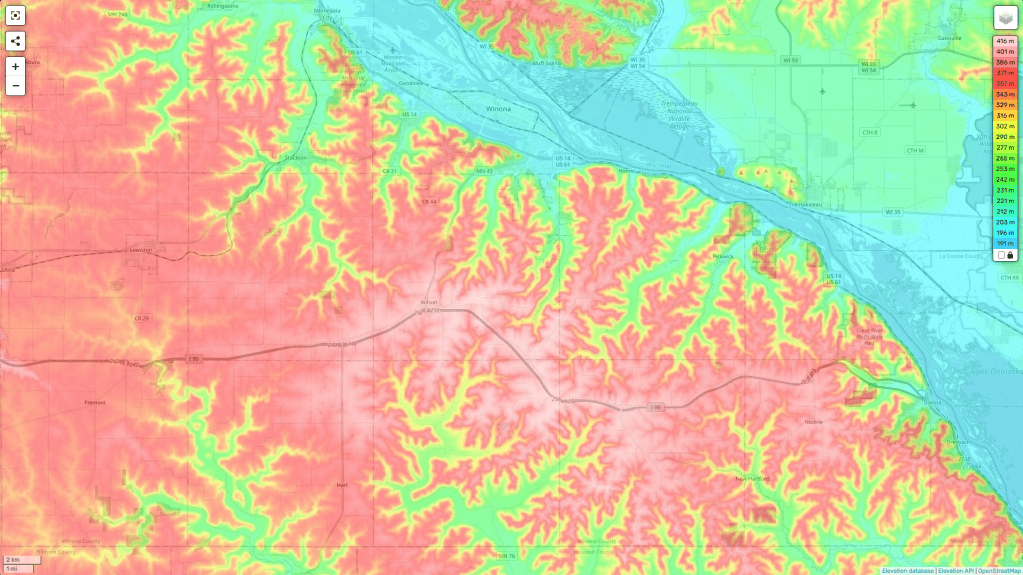
Honestly? Not far off from my current most completed map for Wilderlands (though there’s a much more complicated one in the mix).
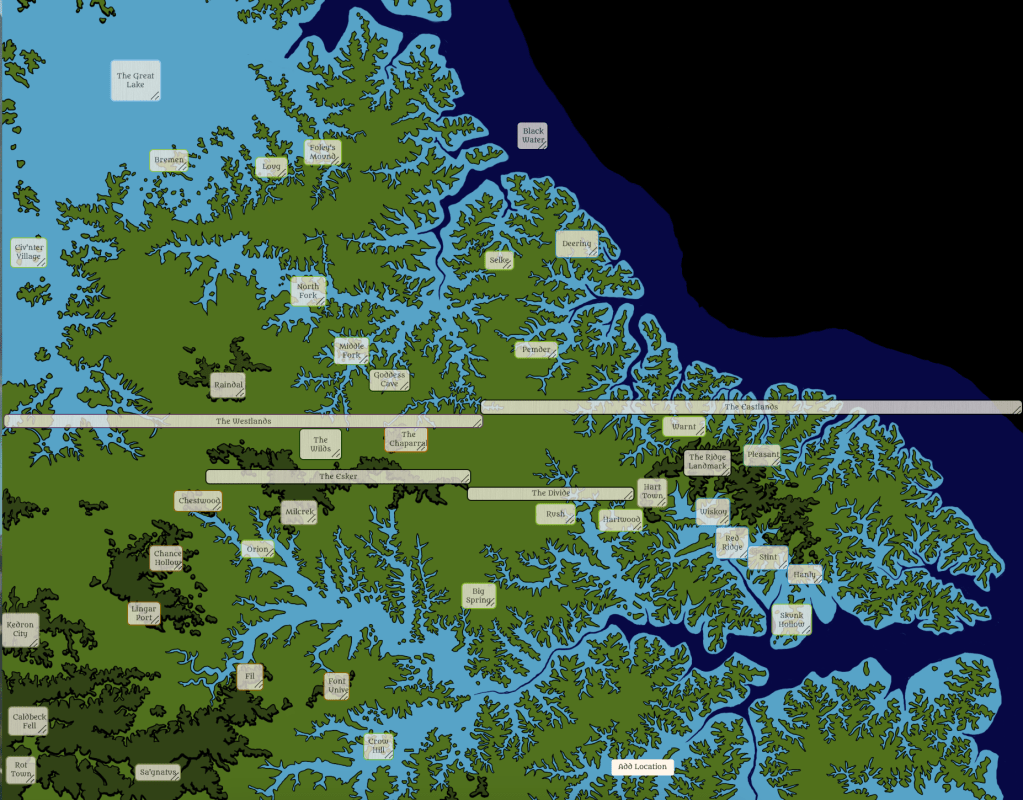
And then I started thinking about how, before the United States was colonized, much of Minnesota was covered in lush, old-growth forests, and there has been some speculation that it may have been home to a temperate rainforest (like what you find now on the Pacific coast) thousands of years ago. So then I covered what remained of the land in forest. And not just forests like we know them today, but a forest like you’d see in any fantasy book. Huge trees, old growth. With canopies that block out sunlight and cause isolated weather events on the ground.
I filled both forest and fresh-water sea with all manner of beasties but with remnants of the animals found here now and in the past. And then gave myself the challenge of fitting my story into that landscape. How would humans have survived? What would settlements look like? How would life change and adapt to suit these conditions?
Finally, things began to look more like I’d envisioned them. Wilder, more untamed, but somehow still home.
I decided humans would have retained parts of names for places, but not the sort of names you see on typical maps. Names only someone from these areas might know. On a map, the intersection of County Roads 4 and 25 has no name, but for anyone who grew up there, you know that’s Schad’s Corner, even if it’s been a long time since any Schads actually lived there. When my dad references areas around the Whitewater River valley where I grew up, he doesn’t talk in terms of roads or even place markers. He references areas by the people who own the land. Many areas are named for the Homesteaders that once settled there in the early 1800s, regardless of whether or not they’re still around.
Then, of course, there’s Minnesota’s older history. Names that only native peoples would know if they haven’t been lost to obscurity. A decided effort was made to eradicate that history, but those people survived that attempted genocide, and I’d be willing to bet they’d survive in an apocalyptic scenario like what happens in Wilderlands.
All of this means I need to consider what alternate names places might have that are used by characters but not on a map–just like we see today.
I might never finish world-building for Wilderlands, but every new bit of information, every piece I slot into the puzzle, gives me new insight and inspiration for the story I’m telling and the people who live within it.

 L. Genevieve Writes
Leave a comment