Welcome back for another installment of my community ed classes on storytelling for middle schoolers! For the second class in the series, I focused on descriptive writing for establishing setting and immersing your readers in the scene.
If you would like to view the original presentation and worksheets in full, you can do so via the following links:
To view the full presentation with all four classes of content, visit this link.
To view the full pack of worksheets that accompany these classes, visit this link.
Let’s jump into it!
Storytelling is more than just creating compelling characters. You also want to create a world that feels lived in. Whether your story is contemporary, science fiction, or high fantasy, it needs to feel real for your readers.
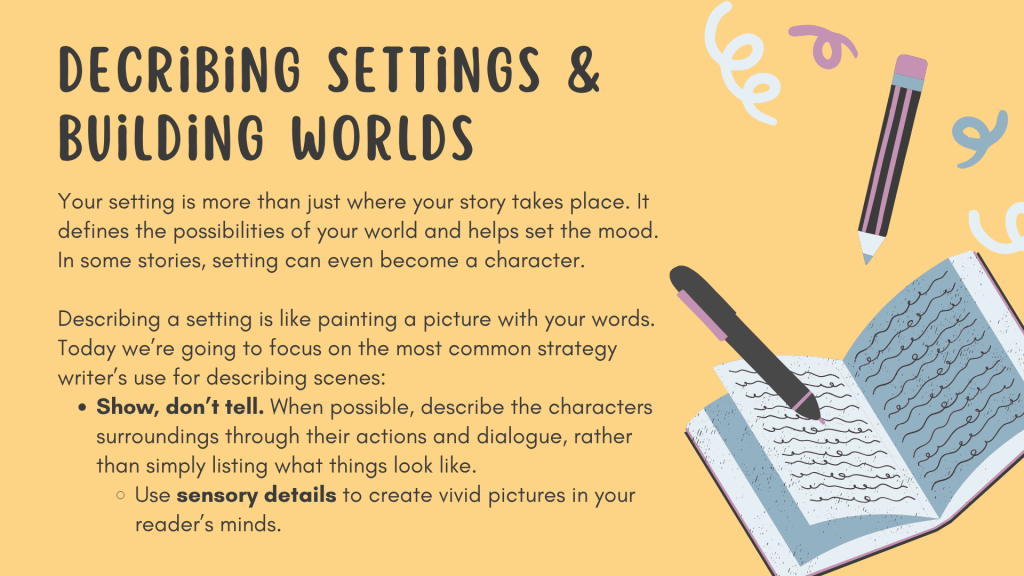
Your setting defines the possibilities of your world and helps set the mood. Sometimes, it can even become a character!
For this class, I’m focusing on some of the most important writing skills for creating a compelling setting. The Show, Don’t Tell method encourages description tied to characters’ actions and dialogue rather than exhaustive lists in block text, and one of the best ways to ensure that your settings come alive for your readers is to use sensory details.
Show, Don’t Tell
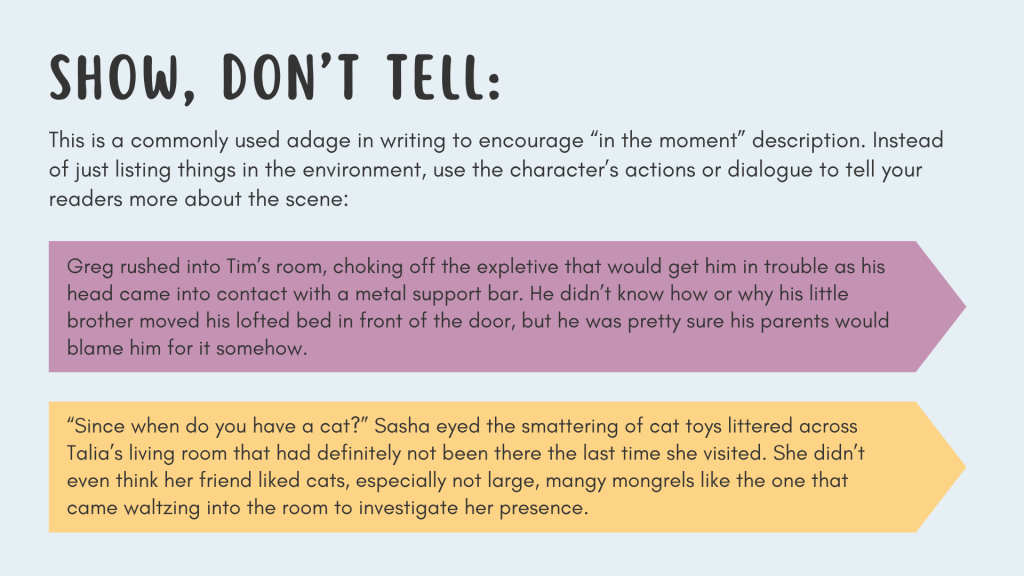
Your readers can glean a lot about your setting from the way your characters react to or interact with it. I’ve provided two examples above where very little description is given about the scene.
In the first, we know a lot about how Tim’s bedroom has been rearranged without ever getting a description of exactly what the room looks like. We can picture the lofted bed sitting in front of the doorway like an impromptu portcullis and can probably even picture the exact style of metal-framed lofted bed that’s being described (maybe even feel the reverberation of hitting our heads on one from our own unfortunate encounters).
In the second example, we may not know the exact arrangement of furniture in Talia’s living room, but we can picture the chaotic mess of pet toys about after the introduction of a new pet, maybe even see a few clumps of cat hair on what used to be a pristine carpet. The detail about the cat being a “large, mangy mongrel” also colors our perception of the disarray the room might be in, as it implies that this cat is probably not very well behaved or well groomed.
Both of these examples are only a couple of sentences long, but we learn so much about the characters and their environments without ever having to list the objects in the room. This is the power of the Show, Don’t Tell method.
Sensory Detail
To help make your descriptions even stronger, you’ll want to combine the Show, Don’t Tell method with sensory descriptions. Sensory language immerses your readers in the scene by tapping into the senses we all use to interact with the world. Descriptions that trigger sensory memories have a stronger impact on your readers and, as a result, feel more real.
Here are some examples using each of your five main senses:
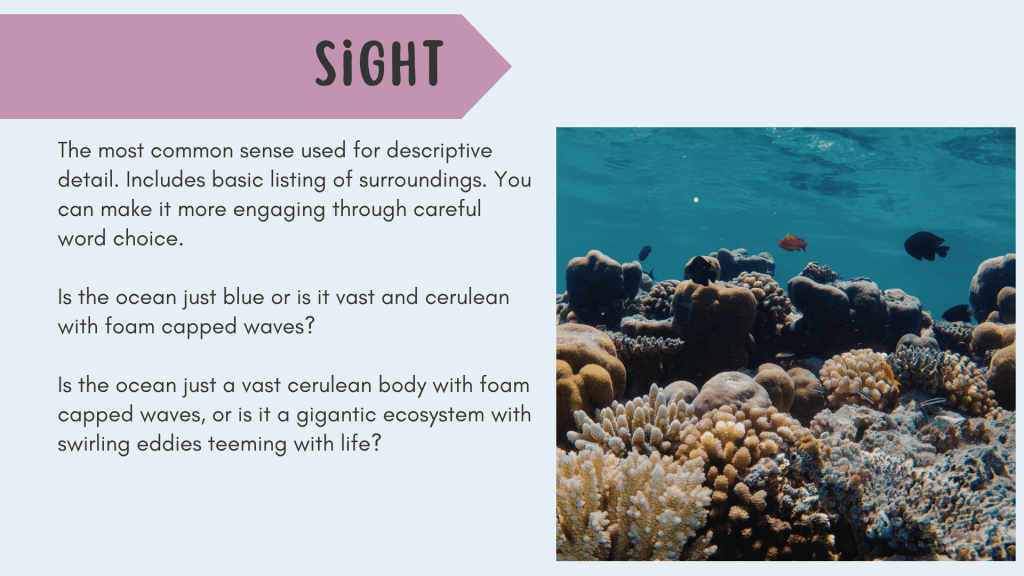
Sight is the most commonly used sense in writing and can include basic lists of items. But you can make it more engaging through careful word choice.
As in the example above, it helps to think about details that might initially go unnoticed or by focusing in on specific aspects of a setting. An ocean might just look like a vast, blue expanse of water on first glance, but it’s so much more than that. It’s surface is riddled with white foam-capped waves and under the surface you can find all manner of diverse and wondrous ecosystems teeming with life.
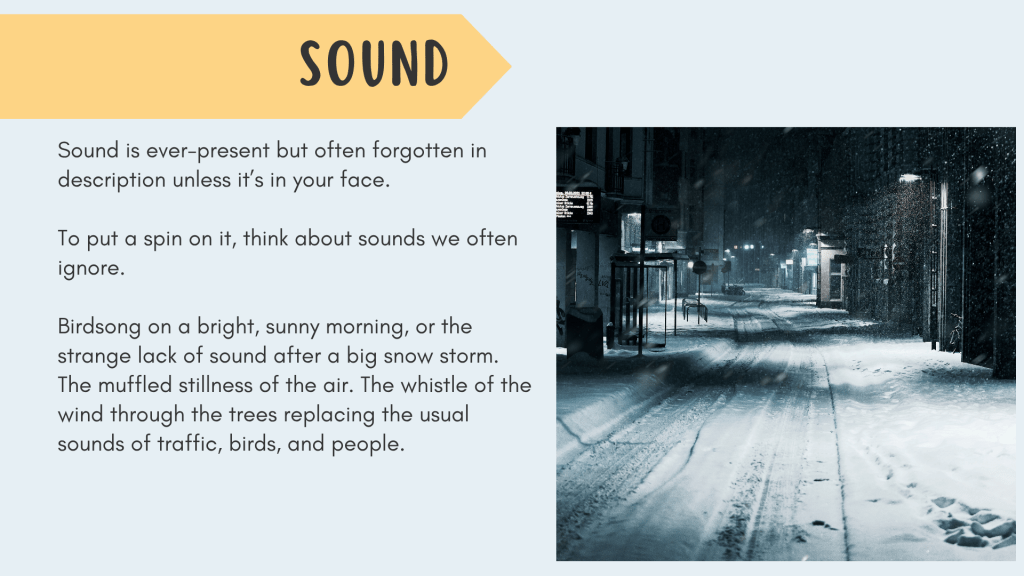
Sound is commonly used in descriptive writing when there are people talking, birds cawing, or cars rumbling. But it can fall by the wayside when sounds are less in your face.
When you’re describing a scene, try thinking about the sorts of sounds that often go ignored. Not just the birdsong of a morning chorus, but the strange muted stillness in the air after a snow storm. Or the whistle of the wind through trees in a forest. Maybe even the hum of an air conditioner as the backdrop to an office scene.
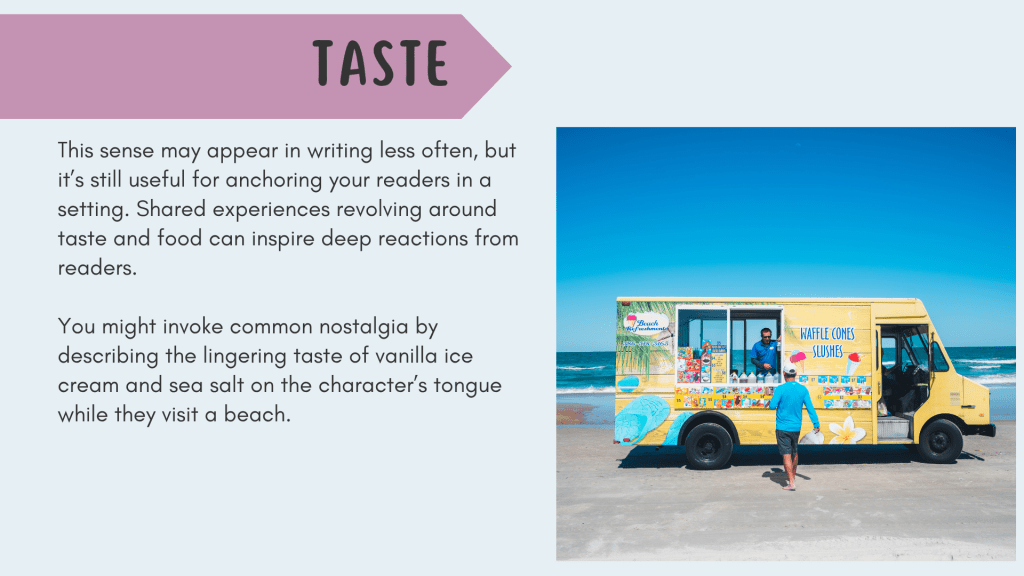
Next up is taste, a sense that usually goes forgotten unless the scene involves eating. But taste memories can be some of the strongest ones we have and so can come in handy to invoke strong emotional reactions.
As in the example above, you might have a character visiting a beach they used to go to as a kid. To trigger a shared sense of nostalgia in your readers, you could draw on the lingering taste of vanilla ice cream and salt in the air as the character fondly remembers their visits as a child.
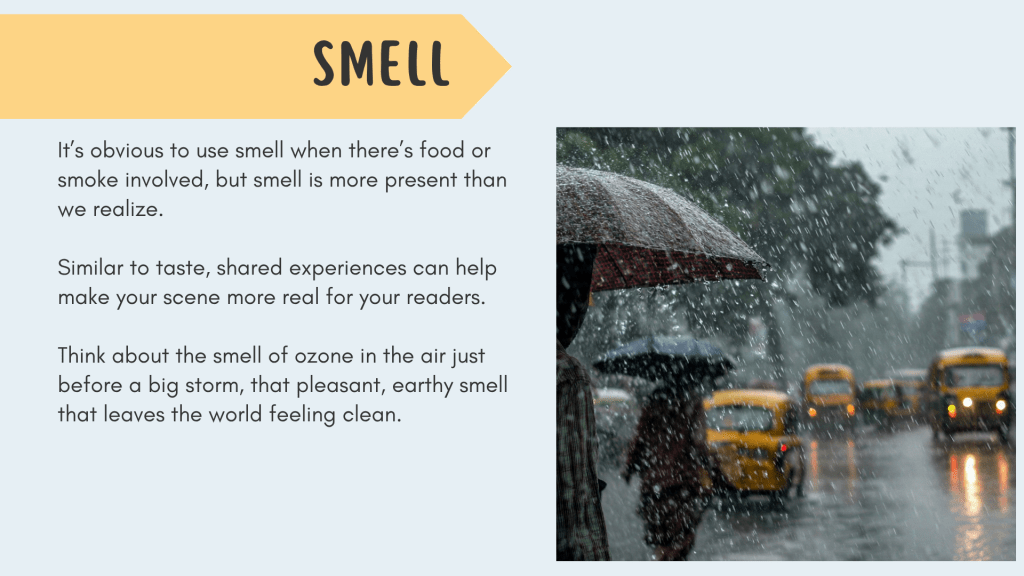
Similar to taste, smell is a sense that usually only shows up when it’s actively invoked by something like food. But you can pull on shared experiences surrounding certain smells to make your scene feel more real for your readers.
The example above talks about the smell of ozone just before it rains, a strong sense that humans have specially developed for survival that all of your readers are sure to understand.
You might also talk about the fishy smell of lake or river water that that clings to everything within a certain vicinity of the shore or focus on the way different people’s houses smell different in a way that is indescribable and yet wholly unique to them.
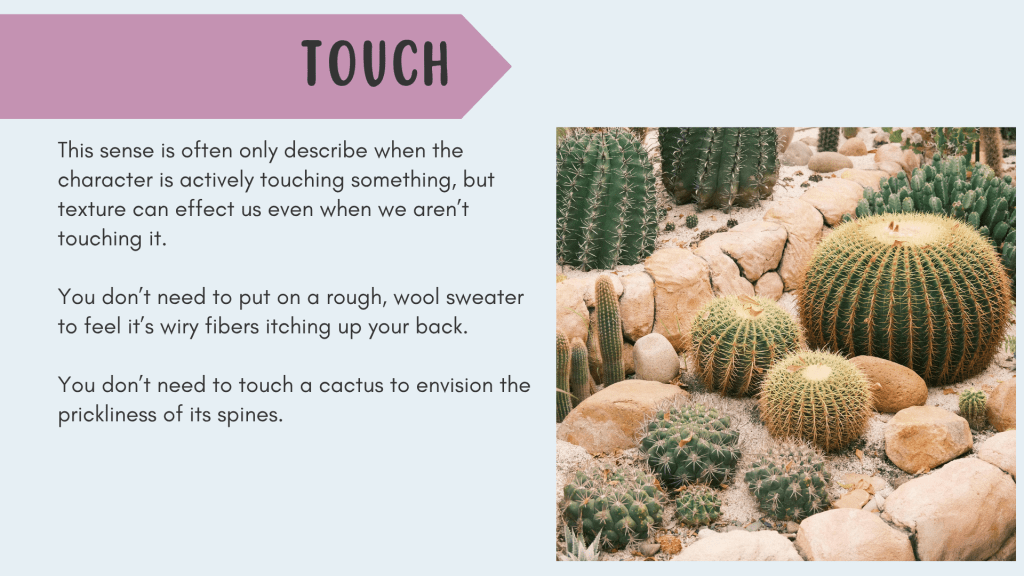
Finally, we have touch. It’s easy to remember to describe textures when your character is touching something, but there are certain textures that cause emotional reactions so strong, we don’t need to actively touch them to react to it.
As in the example above, we don’t need to touch a rough wool sweater or a cactus to know exactly how it will feel (or, for those of us sensitive to rough textures, to draw a shiver down our spines). Just as we don’t need to run our fingers across the smooth surface of polished stone to know how satisfying it will feel.
You can draw on these textile responses to bring your setting to life even if your character isn’t actively touching something.
Activity #1: Describing Your Life
Now it’s time to try out these descriptive methods for yourself. Pick a scene from your own life that you know very well. It could be a place in your hometown, somewhere you go often, or someplace you visited on vacation. Take ten minutes to describe this scene using sensory detail and the show, don’t tell method.
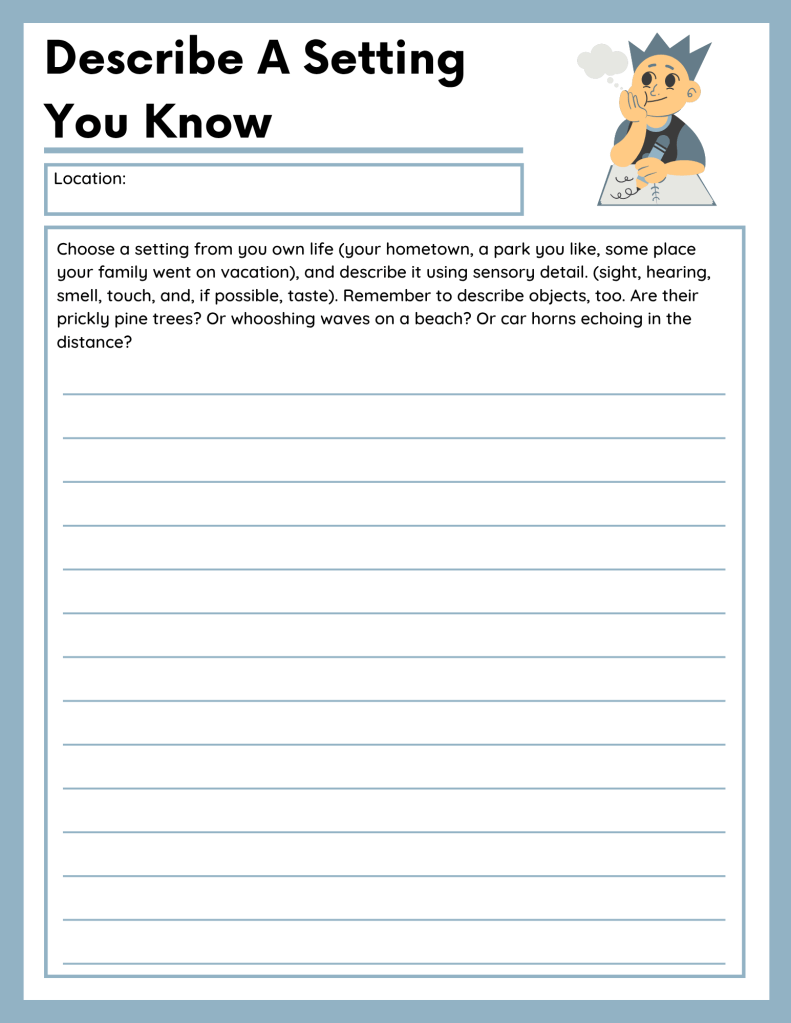
Once you’ve done that, take some time to reflect on the exercise. Was it difficult to write about this setting in great detail? Were you able to easily recall sensory memories to use in your description?
Did it help to pick a setting that you were already familiar with? And did you find yourself remember more details as you were writing?
Our memories are often tied to sensory experience, and so describing them like this helps bring those memories back to life.
Writers often incorporate details from their own life into their writing for this very reason. Even a writer of fantasy novels will pull in details about real places because even the smallest details can go a long way for making your setting feel more lived in.
Something else you may notice as you described your real-life place or read it back to someone else: if you don’t write about something, it doesn’t exist.
Your readers will only see as much as you tell them about. So, if you don’t describe something, it isn’t there.
Or, conversely, if you give them very little description, they might start filling in the gaps themselves. The problem with this being that not everyone will picture the same thing.
The trick to good descriptive writing is finding a balance between giving enough detail that your readers are all on the same page (pun intended) as you, but not so much that they get bored and tune out.
Descriptive writing can be a lot like painting a picture. . .

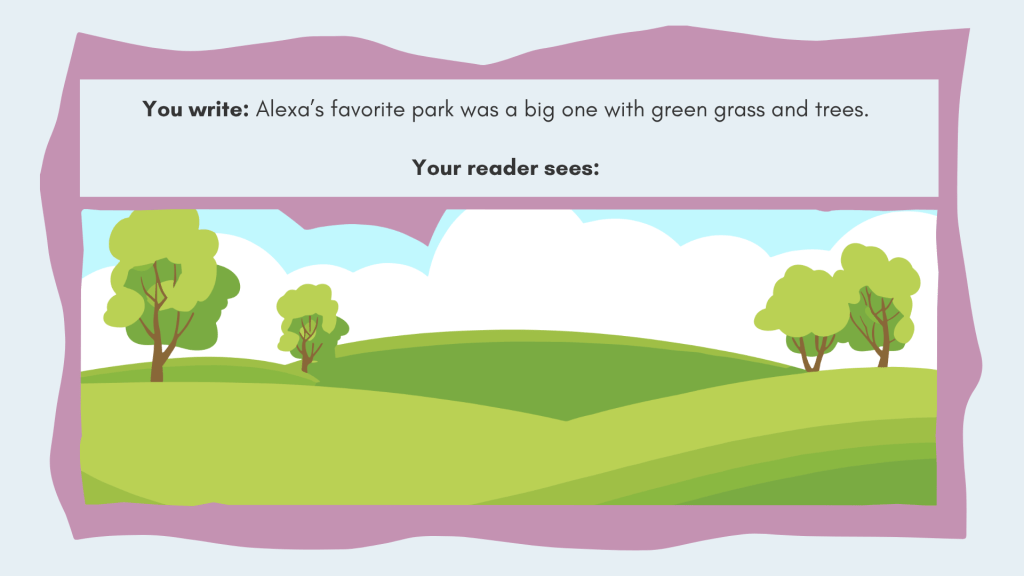
In this example, we only know that Alexa’s favorite park is big with green grass. So if we drew a picture based on that, it would just be . . . a bunch of grass.
Some readers might see the work park and think playground and so insert that in even though it hasn’t been described. Others might be more familiar with parks with walking trails. Either way, we’ve been given so little detail, we’re likely all picturing something different.
So, let’s try again . . .
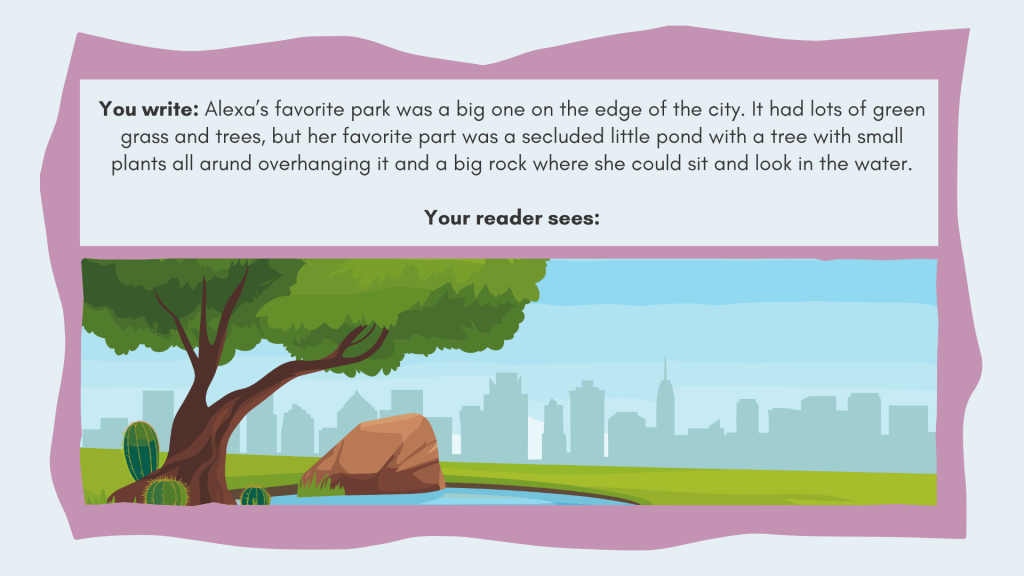
In this example, we’re given more detail than the first. Now we know that the park Alexa likes is big with green grass and trees. But a picture of it is still just going to be a big area full of grass, now with a few trees.
Again, it hasn’t really centered us on a specific area and readers are probably filling in the gaps with whatever their idea of a park is.
So, let’s take it one step further . . .
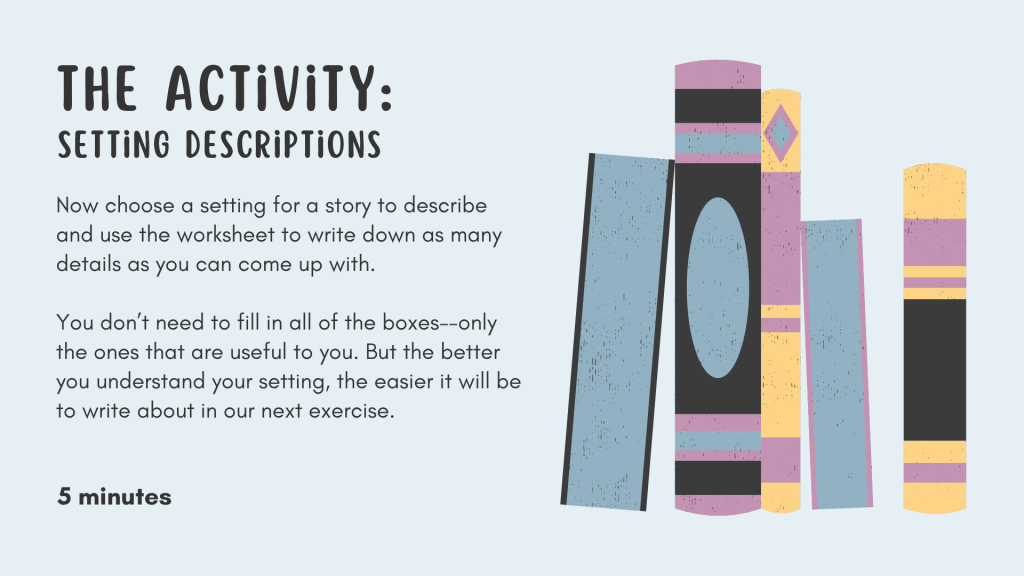
In this final example, we now know not only which park is Alexa’s favorite, but we know where it is in relation to the city, and we even know what her favorite part of the park is.
Now we can clearly picture the little pond and its tree with a rock perfect for sitting on. Readers might still have some minor differences in how they’re picturing the park, but if Alexa is hanging out at the pond, we’re all probably picturing something similar.
As you can see, details make all the difference in descriptive writing. Not just adding more details, but choosing the right ones to ensure that your readers see what you see. Keep this in mind as we move into our next activity. . .
Activity #2: Setting Description
Now it’s time to choose a setting of your own. To start with, I want you to take 5 minutes to write down as many details about your setting as you can think of. In the worksheet below, I’ve broken out all of the most common details for a setting to help get you thinking. However, if there are categories that don’t matter to your setting or if you simply don’t know the answer to it yet, skip it!
This worksheet is just to help you get started.
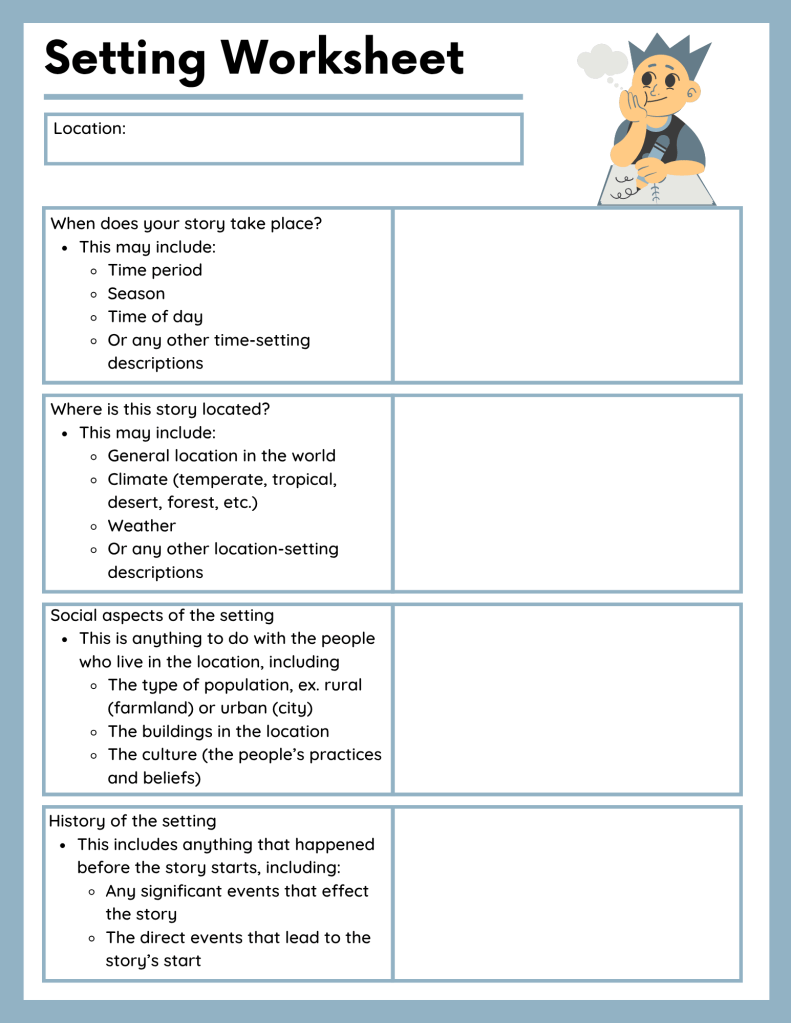
I hope that this exercise helped you get more familiar with the setting you have in mind. The intention was to get you thinking about details you might not have considered and help you better understand the setting you’ve chosen.
Because in our next activity, you’ll be bringing all these details together . . .
Activity #3: Setting Descriptions
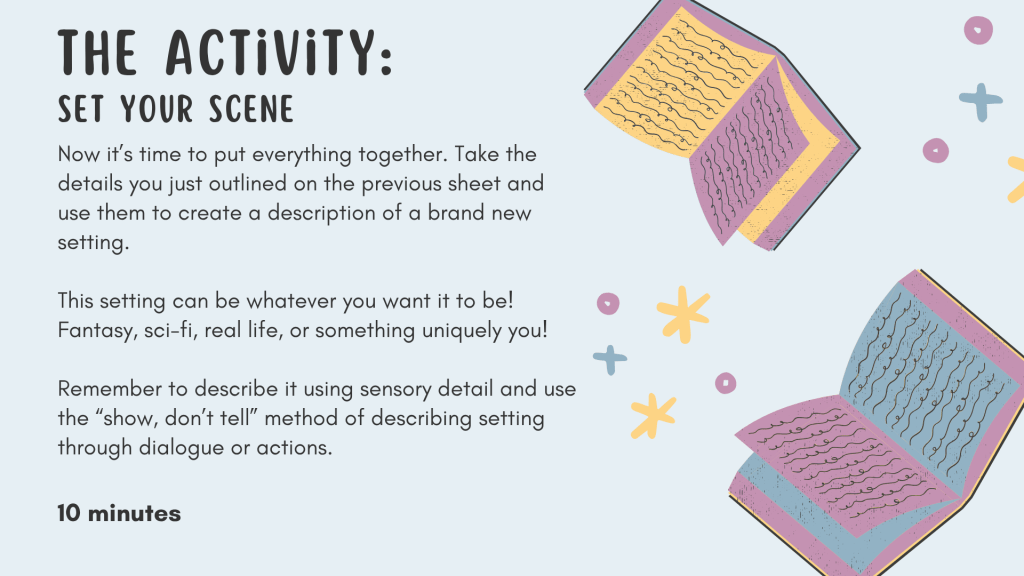
For our final activity, it’s time to put everything together! Using the worksheet you just filled out, take 10 minutes to write a description of the setting you’ve chosen.
Remember to use sensory details and the show, don’t tell method of description to help make your setting feel more real.
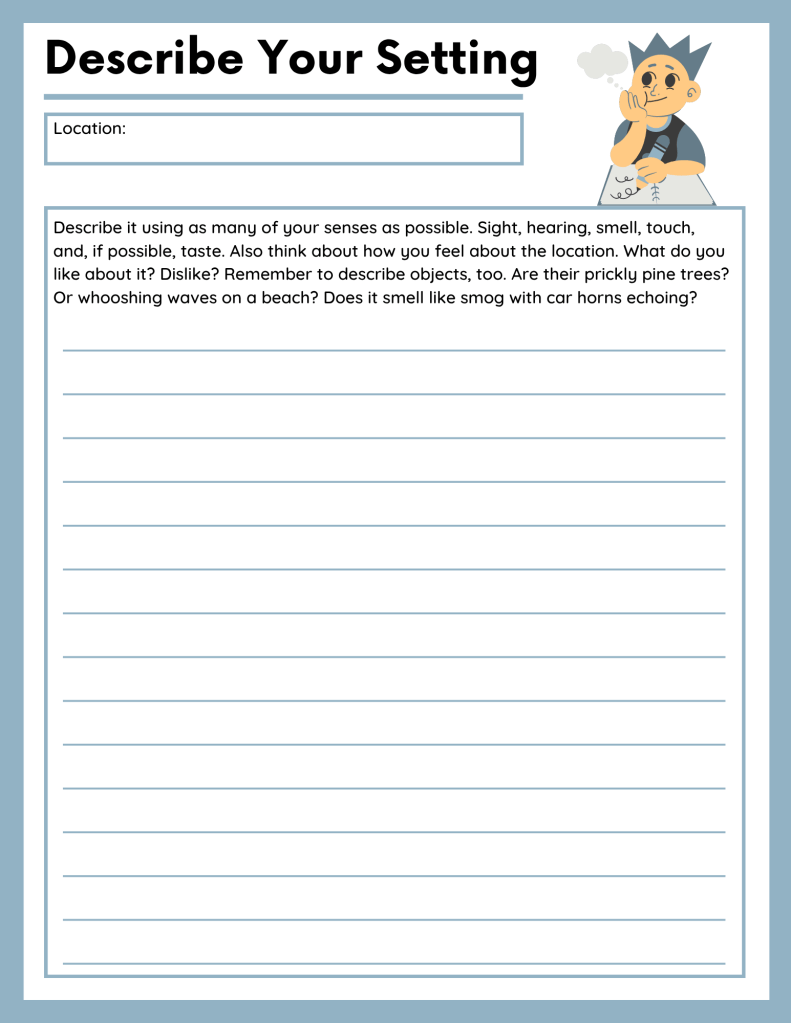
Once you’ve had a chance to write about your setting, take a moment to reflect in this exercise. Did getting to know the setting with the worksheet beforehand help make it easier to write about in the final activity?
Writers will often do exercises just like these ones to get to know their settings better either before they start writing their novels or before they start editing their rough drafts. Many writers even make worksheets like the one we just did to help them remember details about their settings that they can refer back to as they write.

I hope that this class has helped you understand the importance of descriptive writing and how to use it in your stories as you build out the settings of the world you’re creating.
If you found the exercising inspiring, try expanding on them by exploring more settings! After all, very few stories only have one setting.
I’ll be back next week (ish) with the next installment for this series, where we’ll take a look at how to create effective conflict for your characters and how they’ll overcome it!

 L. Genevieve Writes
Leave a comment