Welcome back for the third and final installment for this series (as the 4th class I taught was an unstructured free-writing hour). I may do one more blog post reflecting on what I learned doing these classes and how I plan to change them in the future, but this will be the last of the class content.
In this post we’ll be taking a look at creating realistic conflict and learning about the different types of conflict characters face in stories.
As always, you can view the original presentation and worksheets for this course at the following links:
To view the full presentation with all four classes of content, visit this link.
To view the full pack of worksheets that accompany these classes, visit this link.
Conflict is a key ingredient in all good storytelling. It’s the “why” behind the story being told and it’s what drives it forward.
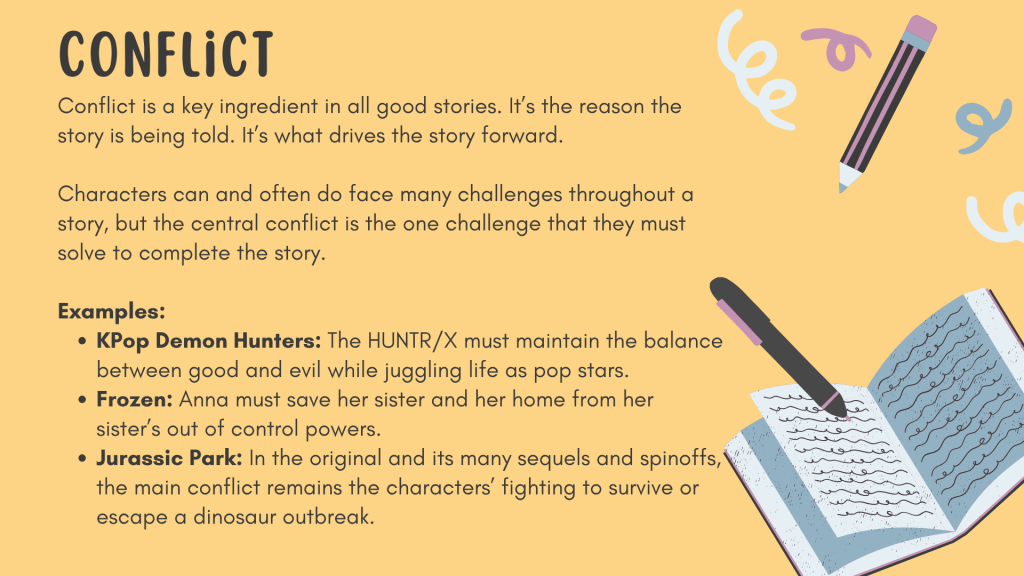
Most stories that are longer than a nursery rhyme will have several conflicts that intertwine with and build off of each other, but only one will be the “central conflict.”
The central conflict runs the full length of the story and is the main thing that your characters need to solve before the story ends. I’ve given a few examples in the image above, but a few more of the most common examples include:
- The Lord of the Rings: The Frodo (and the rest of the fellowship) must get the ring to Mordor and throw it into the volcano to destroy it and thus save Middle Earth.
- In any Star Wars film: The central characters must defeat the dark side while avoiding its lure.
Of course, in all of these examples, the story feels incredibly bare when stripped back to just its central conflict. So we can already see the importance of having complex, multi-conflict stories. But today, we’re going to work on building just one conflict for a character to face.
But conflict isn’t just something we see in stories. It’s something we face in real life, too. So to start us off, I want you think about a challenge you’ve dealt with in your own life.
Activity #1: Exploring Conflict
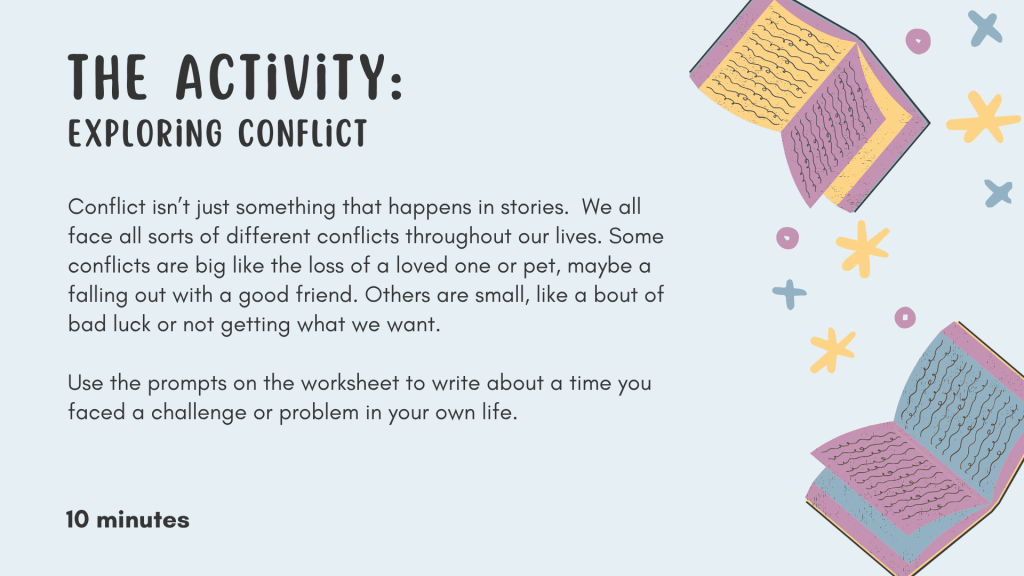
For this activity, I want you to choose one challenging situation you’ve faced in your life. It can be as simple as not getting something you really wanted or more complex like the loss of family pet. Take 10 minutes and use the prompts on the worksheet to explore the conflict in more detail.
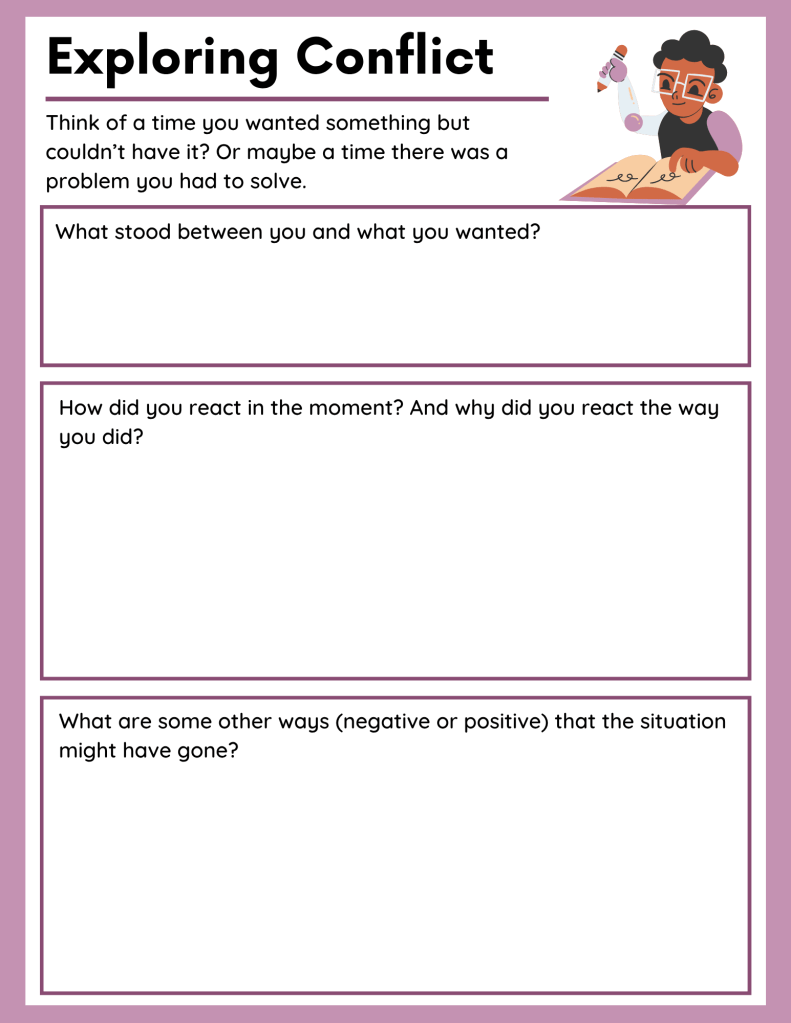
One very important thing to keep in mind as you reflect on your own challenges in life, is that we don’t always respond to situations the way we wish we did. Maybe we lash out in anger and hurt someone we love, or maybe we’re so scared we freeze up when we wish we had acted. Sometimes, even if we know what the “right” way to respond to a situation was, we just don’t.
Whenever we face a conflict in life, we have a choice about how we react. The key to creating good conflict for your stories is to have characters who, like us, don’t always do the right thing or who struggle to react the way they wish they could.
If you’ve already gone through my Creating Characters blog post for this series, think about what personality traits might motivate your character’s decisions when facing challenges like these. Each character will have a unique set of traits that influence the decisions they make.
Now that you’ve had a chance to explore conflict in your own life, let’s take a closer look at how conflict is created in stories.
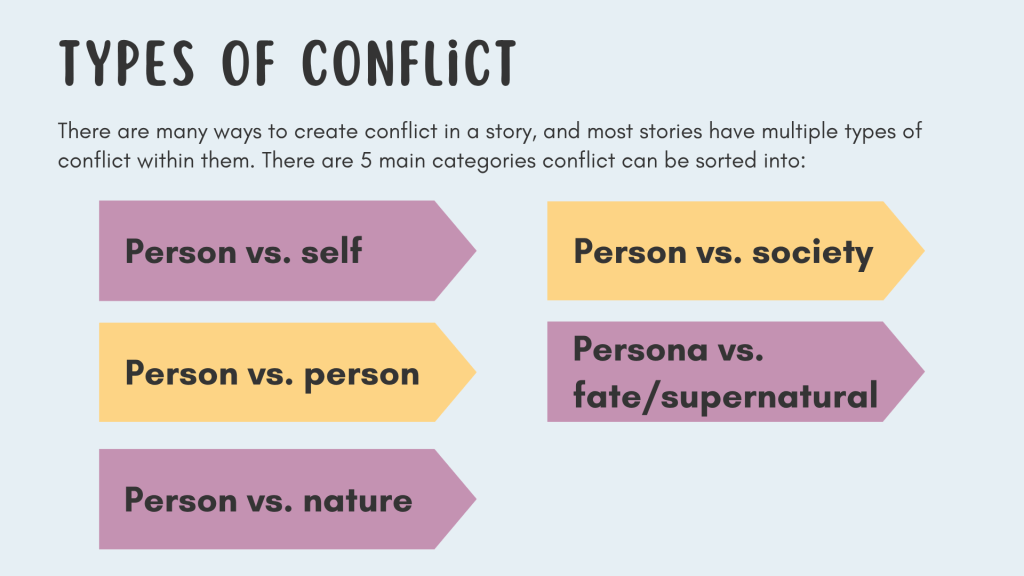
Depending on which teaching you’re following, there are anywhere up to 7 categories of conflict in storytelling, but I’ve combined them here into 5. These categories focus on how the conflict relates to a specific character based on what they’re facing, and, just as most stories have multiple conflicts, it isn’t uncommon for a single character to face multiple conflicts.
Let’s take a look at each one in detail. As I go through each of these categories, try to think of examples from books and movies you know.
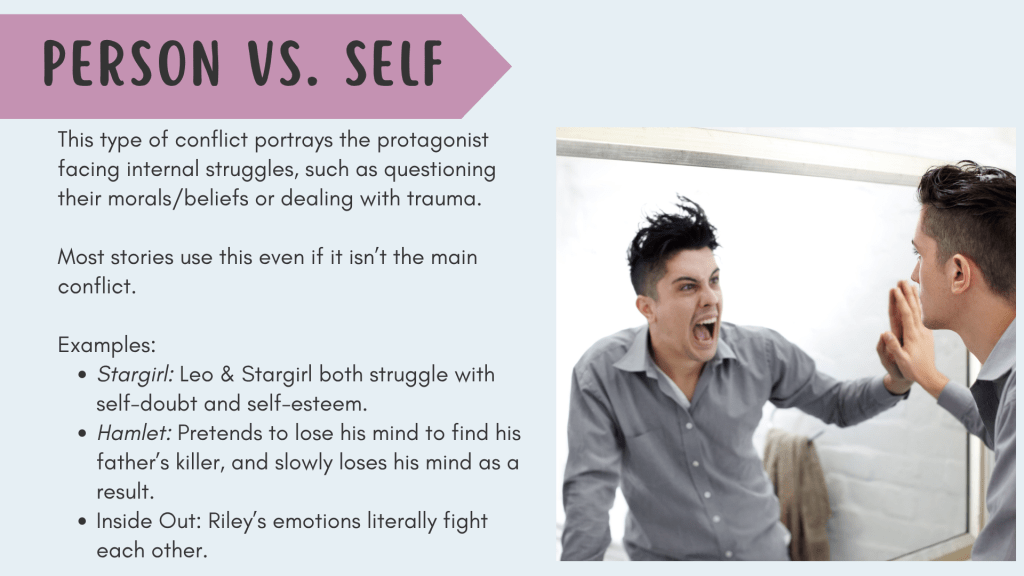
First up is Person vs. Self. In this type of conflict, the character is battling their own inner thoughts or emotions. It often focuses on struggles with morals or beliefs or revolves around dealing with trauma.
We see this in books like Stargirl where both Leo and Stargirl struggle with self-doubt and questioning who they are in the face of bullying from other students. We also see this in Hamlet where the titular character battles his inner demons as he hunts for his father’s killer.
One fun twist on this idea is Pixar’s Inside Out series, where we see Riley’s emotions literally fighting each other as characters in the story.
Most stories will use Person vs. Self in some form, even if it isn’t the main focus of the story, as character growth is an important feature to good storytelling.
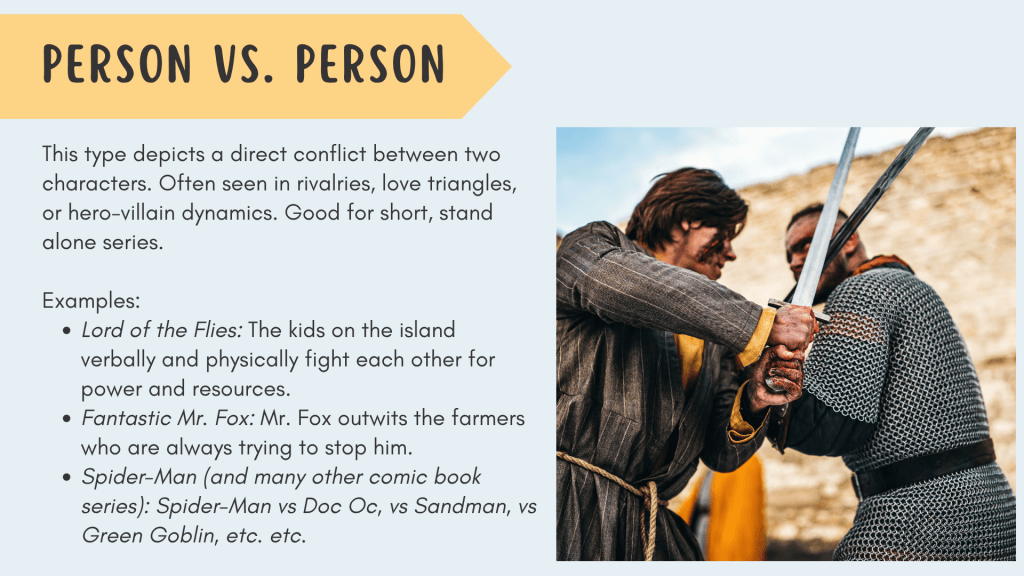
Next is Person vs. Person. This category pits one character against another. It’s most commonly seen in stories with heated rivalries, love triangles, and hero-villain dynamics.
It’s great for series with short, stand-alone story arcs, which is what makes it so popular with the comic book format. Pick any superhero and a villain they face, and you’ve got a Person vs. Person conflict. In the slide above, I’ve listed Spider-man and man of his most common foes.
We also see this conflict play out in books like Lord of the Flies where the boys on the island fight one another for power and resources, and Fantastic Mr. Fox where we see Mr. Fox outwit the farmers over and over again.
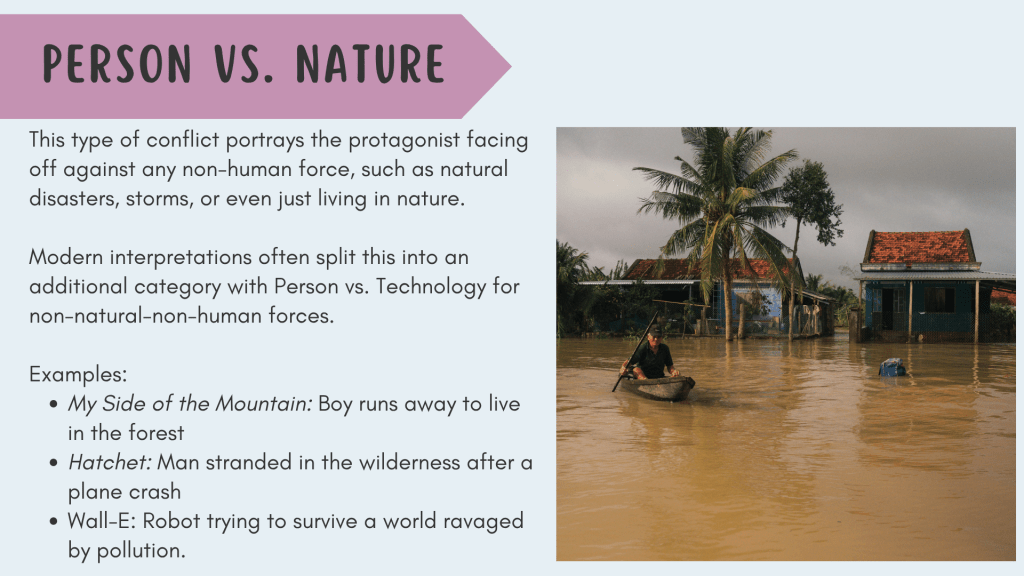
Person vs. Nature is seen in stories where a character faces off against non-human forces like natural disasters, forms, or even just surviving in nature.
Modern interpretations often break this out into two categories including Person vs. Technology as a separate category for any non-human-non-natural forces a character may face, such as robots or AI. Traditional interpretations include those under this same umbrella.
The most famous examples of this type of conflict include any story where a character is surviving alone in nature, such as My Side of the Mountain or Hatchet (also see basically any Jack London book).
The Pixar movie Wall-E is one that straddles the grey-area between Person vs. Nature and Person vs. Technology since the little robot is trying to survive in a world destroyed by human pollution.
Person vs. Technology is seen most often in science fiction like Frankenstein or The Matrix series.
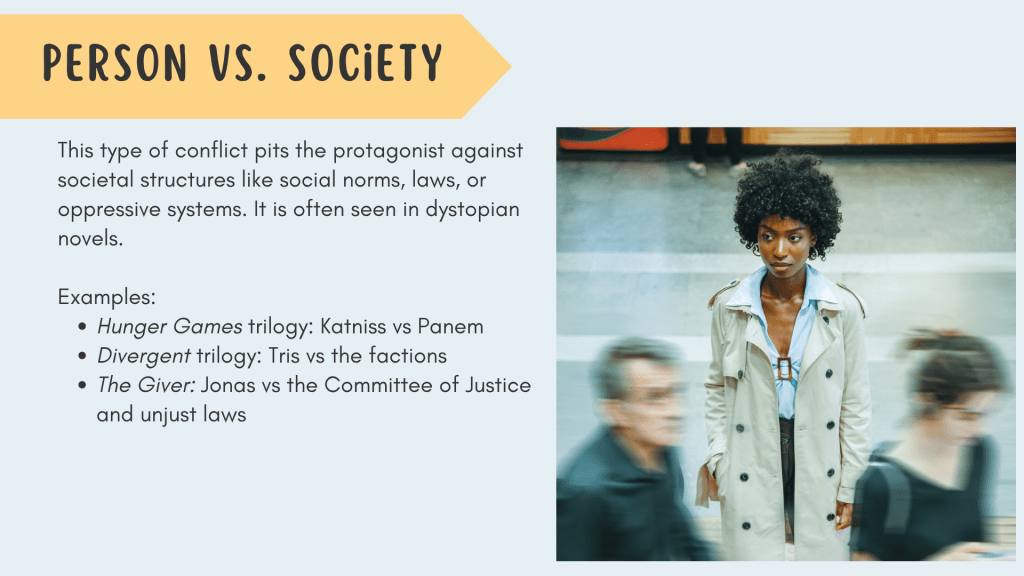
Person vs. Society includes any story where a character must fight against societal structures such as social norms, laws, or oppressive systems. It is most commonly seen in dystopian sci-fi novels and movies.
We see this in The Hunger Games trilogy as well as the Divergent trilogy. We also see it in classics like The Giver and 1984.
You might even look at movies like Star Wars as an example of this, as they usually focus on just one or two characters who must face off against the Empire’s forces to save the day.
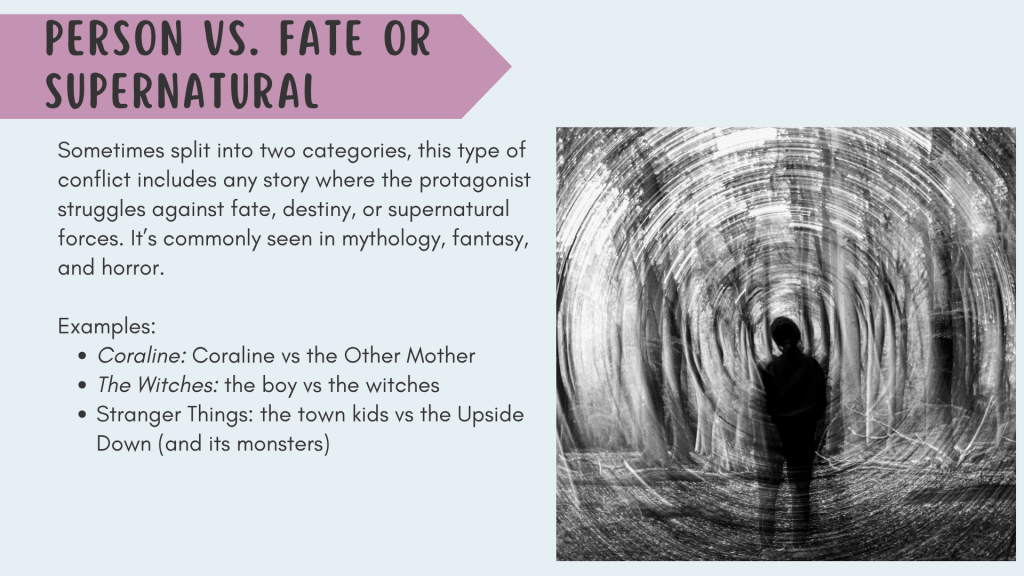
Finally, we have Person vs. Fate or the Supernatural. Like Person vs. Nature you will sometimes see this one split into two (or even three) categories in different interpretations. But in general, this category includes any conflicts where a character struggles against forces outside of human comprehension, whether that be something like hauntings and magical creatures or fate and the gods themselves.
You see this in stories like Coraline where she must defeat the Other Mother to rescue her family (and save her soul). In The Witches, the boy must find a way to stop the evil group of witches that want to rid the world of children.
You also see this commonly in supernatural TV shows, like Stranger Things which hinges around the kids of Hawkins fighting the monsters that come out of the Upside Down.
As you can see there are many different ways to create conflict in stories, whether your characters are facing their inner demons or literal ones. When you’re creating stories and characters of your own, they may come up against many different challenges. Thinking about it in terms of these categories is just one strategy you can use to come up with unique storylines that fit the genre of your story.
Activity #2: Creating Conflict
Now that you’ve learned a little bit more about conflict and what it looks like in stories, it’s time to try it out for yourself! Pick of character of your own creation (it can be the one you created in the first part of this series) and come up with a challenge that they would face in their story.
Take 10 minutes to explore that conflict in more detail, using the prompts on the worksheet. The conflict you choose can be big or small. It can be internal (Person vs. Self) or external (Person vs. Person, Person vs. Society, Person vs. Nature, Person vs. Fate/Supernatural).
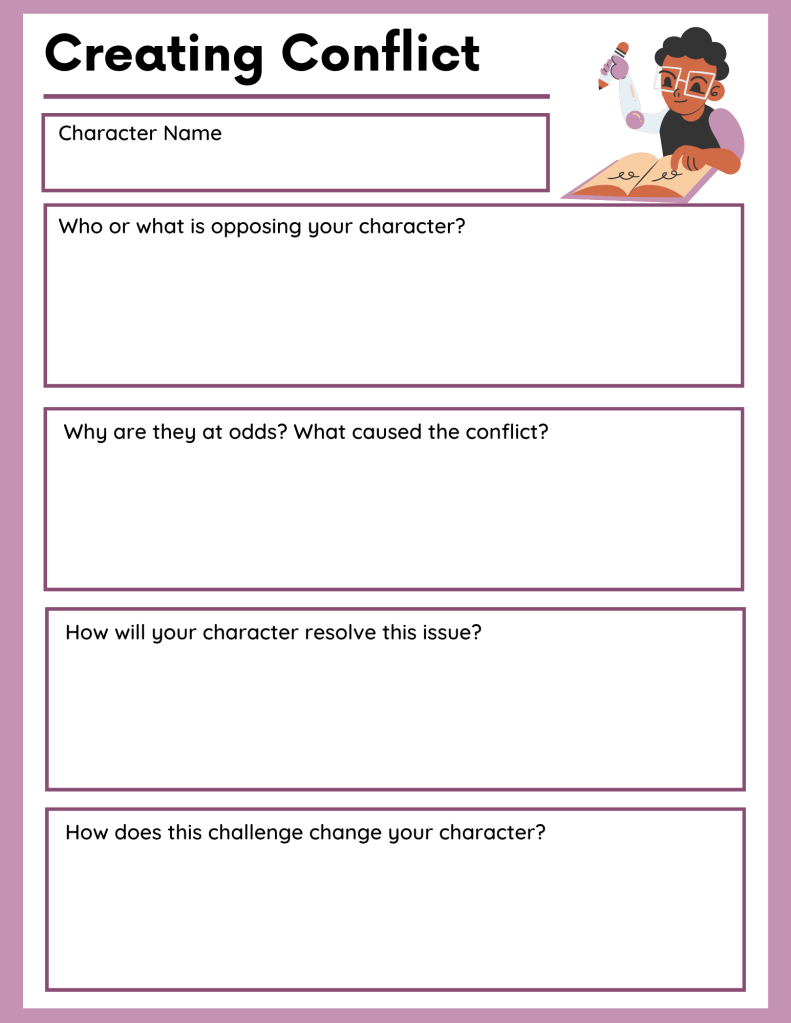
As you’re exploring, think about the personality traits this character has and how they would respond to different challenges. Are they the type to go in guns blazing? Or are they more likely to hold back until they’ve had time to think everything through?
Also think about how the conflict might resolve, or, in the very least, how the character plans to resolve it. Do they choose to do what’s right or what’s easy? And does their plan succeed? Maybe they try to fix their problem but only make it worse.
Finally, think about how facing this challenge might change your character. Does it make them a better person, or did their choice only make things worse? Did they react how they wanted to in the moment? Did their choice cause them to lose friends or allies? Or did they make allies out of enemies?
Once you’ve finished this exercise, reflect on where this conflict falls in your greater storyline. Is this the central conflict that drives your story forward, or a side conflict that influences the rest of the story? Does the solution your character comes up with fully resolve the conflict, make things worse, or maybe only partially fixes the problem?
Just like in real life, different characters will respond differently in situations, and, just like you, they’ll face many conflicts throughout their stories. If what they do in this scenario only partially fixes a problem, then that problem will come back up later. Many stories (especially fantasy and sci-fi) will use this strategy to sustain tension and up the stakes across long storylines. Many times, the first solution to a problem only makes it much worse and creates more problems that the characters have to face down the road.
Keep all these things in mind as we move into our final activity for this section.
Activity #3: Putting Yourself in Their Shoes
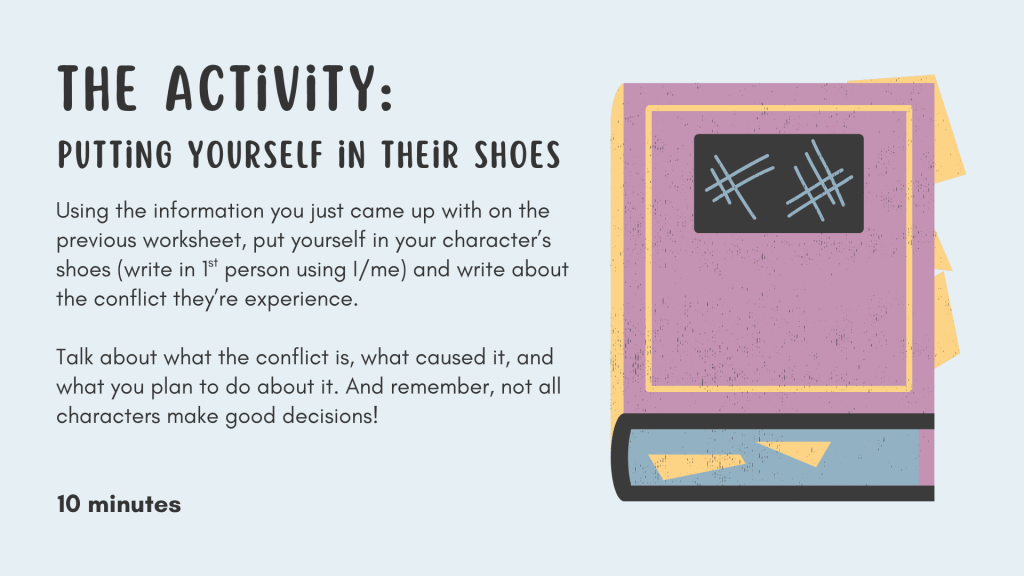
Now that you’ve had a chance to explore a conflict one of your own characters will face, it’s time to put that information together in one final writing exercise. Using the worksheet you just completed, put yourself in your character’s shoes (write in 1st person POV using I/me) and write about the problem you’re facing and what you plan to do about it.
You can write it in the present tense, as if they’re facing the conflict in real time, or you can write it in the past tense, like a diary entry where they’re reflecting on the situation and how they handled it. Whichever way you decide to write about it, you should focus on how the character is struggling with this problem and what they plan to do about.
And remember: not all characters make good decisions!
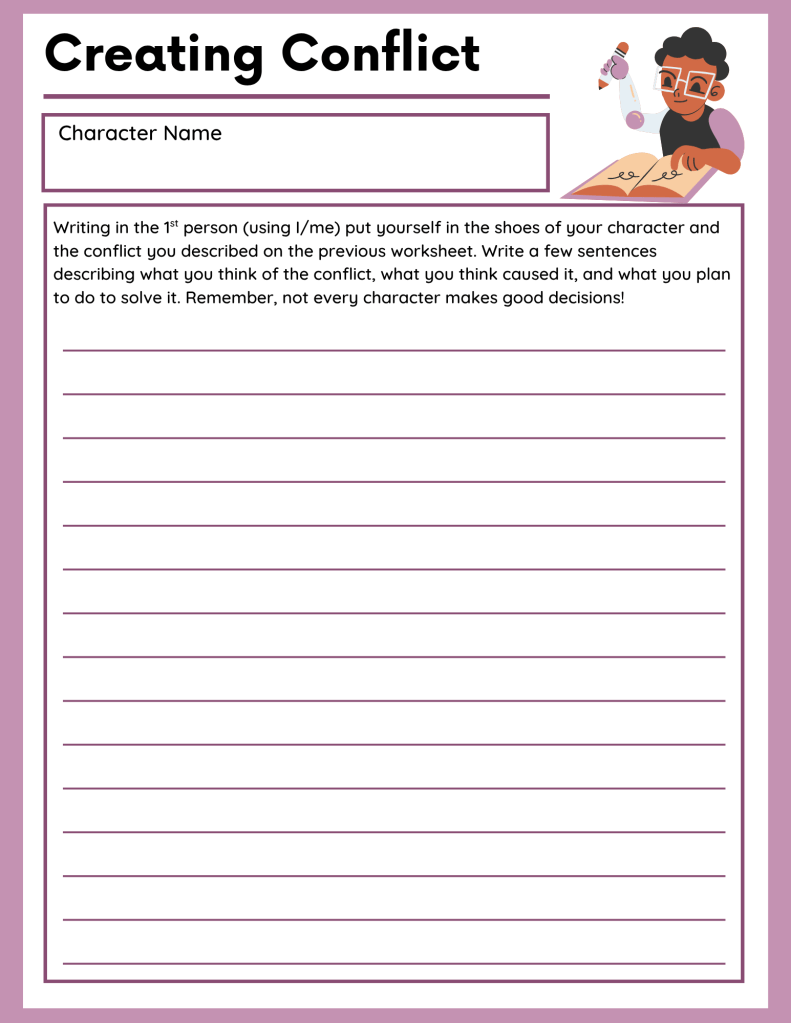
Once you’ve finished this writing exercise, take some time to reflect on it. Did the worksheet we did in the previous exercise help make the conflict feel more real when you wrote about it here? Or, as you wrote in your character’s voice, did you find them reacting differently than you thought they might?
Did their solution to the problem feel like how real people would respond if they were facing the same conflict? Or did the character’s actions feel exaggerated and dramatic?
For some types of stories (like action movies and musicals) dramatic, over-the-top reactions can be normal, but in most cases, audiences want stories where the characters behave like real people. An over-the-top reaction to a situation from a character who is otherwise level-headed will leave your story (and by extension your audience) feeling off-kilter.
Keep tweaking your conflict and how your character responds until it feels both believable to how normal people react and to your character and their personality.
Authors will often use exercises like the ones we just did either before they start writing or after they’ve finished a rough draft to help them better understand the conflicts their characters are facing and whether they’re in line with that character’s personality and the story being told.
If you enjoyed these exercises, try doing them again with different characters or different conflicts. Exploring all of the different problems that crop up in your story from each of your characters’ point of view will help you better understand both your characters and the world you’re creating for your story.
That wraps up all the structured sections from my storytelling bootcamp for middle schoolers. If you’re reading this as an aspiring writer, I hope this left you feeling motivated and excited to start working on your own story. I hope it gave you the tools you need to flesh out the characters you’ve created and the world they live in, and I wish you the best of luck on your writing journey!
If you’re interested in learning more about my journey through this process, keep an eye out in the next week or so for my final wrap up post on this series. I’ll have some thoughts on how this went and what I’m planning on doing in the future.


Leave a Reply